Students
A lecture recording needs to become searchable study material in a familiar document workflow.
Review the draft, correct terminology, and organize the transcript with notes.
Google route
Google transcribe audio to text workflows can be useful when your files already live in Google's ecosystem. This guide separates Google's built-in options from a general-purpose transcription route.
Google's route is most distinctive when the surrounding work already happens in Google products.
Choose the Google path when the job is closely connected to search, documents, or an existing Google workspace.
A lecture recording needs to become searchable study material in a familiar document workflow.
Review the draft, correct terminology, and organize the transcript with notes.
A call recording contains decisions, follow-ups, and names that are easy to forget after the meeting.
Create a readable starting point for minutes instead of replaying the full recording.
Interviews or field recordings need to be searched for themes and quoted accurately.
Use transcription as a first pass, then verify every important quote against the audio.
A spoken outline or recorded interview needs to become editable source material.
Move from audio to a structured draft before polishing the final article or script.
The exact screens can vary by device and Google product, but the working pattern is straightforward.
Decide whether the recording belongs in a Google document, a Google AI workflow, or another Google-supported transcription surface. Start with the destination, not just the file.
Use a clear recording and check that the selected tool accepts its source. Reduce background noise where possible, because transcription quality cannot recover words that are missing from the signal.
Read the transcript against the audio, correct names and technical terms, then format headings, speakers, and action items for the people who will use it.
Google is convenient when its ecosystem is already part of the job. A general transcription tool is usually easier when the only requirement is a clean text result.
| Google transcription route | General transcription route | |
|---|---|---|
| Best starting point | A task already centered on Google products | A standalone audio-to-text job |
| Setup | May depend on the selected Google surface and account context | Usually upload audio, choose options, and export |
| Workflow context | Convenient for connected documents, search, or Google AI tools | Designed around transcription itself |
| Input flexibility | Depends on the particular Google product | Often presents one clear upload path for supported files |
| Editing | Useful when the transcript will continue in a Google workspace | Useful when you want dedicated transcript cleanup and export |
| Privacy decision | Review the data handling of the specific Google service you select | Review the policy and retention terms of the chosen transcription provider |
| Ideal outcome | A transcript that fits into a broader Google workflow | A focused text file or editable transcript |
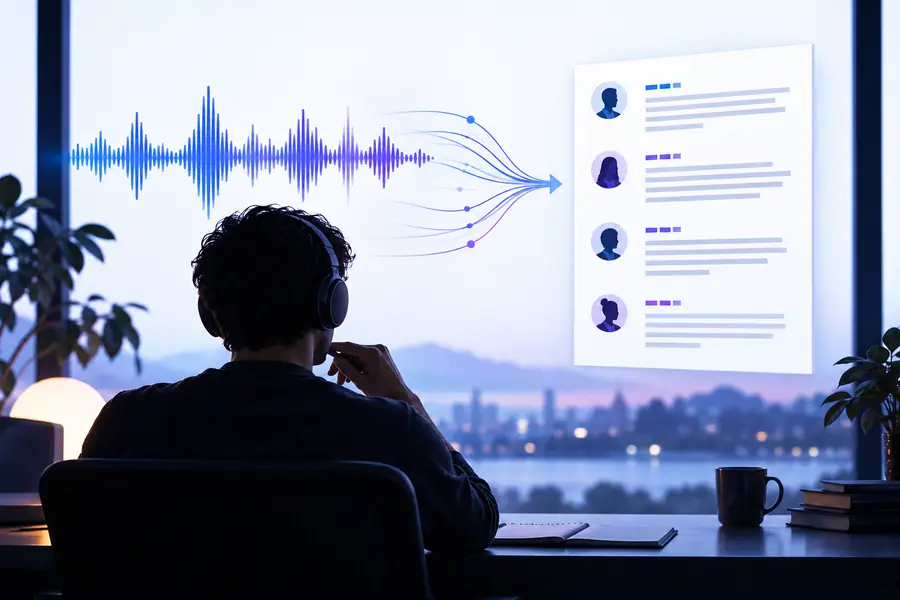

The output still needs human review, especially for names, numbers, and overlapping speakers.
Audio taskWorking transcriptA Google route is not automatically the best answer for every recording or every privacy requirement.
Google has several products and features that may handle speech differently. The steps, supported inputs, and editing experience depend on the surface you choose.
What to do instead
Identify the destination first, then confirm that it supports your recording and required output.
Automatic speech recognition can mishear names, jargon, accents, crosstalk, numbers, and quiet passages. A raw draft should not be treated as a verified record.
What to do instead
Keep the audio beside the text and proofread important passages before publishing or quoting them.
Sending an audio file through a cloud service creates a data-handling question, especially for interviews, legal material, health information, or confidential meetings.
What to do instead
Check the selected service's privacy terms and remove sensitive material when possible.
A Google-centered workflow can become slow if you have many files, strict naming rules, or a specialized export format.
What to do instead
Use a dedicated online transcription workflow for repeated uploads and consistent delivery.
Try a focused transcription workflow when you want to move from spoken material to an editable draft without spending time comparing every Google product first.
These answers address the common search intent behind Google's audio transcription route.
Yes, some Google products and services can convert speech into text, but the exact experience depends on which Google surface you use. Check the specific product's supported inputs, languages, and editing features before relying on it for an important recording.
The easiest route depends on where you want the result to live. If the final work belongs in a Google document or AI workflow, use the Google surface that accepts your recording; otherwise, a general online transcription tool may involve fewer setup decisions.
Some Google transcription features may be available without a separate transcription purchase, while others depend on the product, account, device, or usage terms. Confirm the current conditions for the exact Google tool before uploading sensitive or time-critical audio.
It can provide a useful first draft, but accuracy varies with recording quality, accents, background noise, terminology, and overlapping speakers. Always check names, numbers, quotations, and key decisions against the original audio.
Safety depends on the Google product, your account settings, the audio content, and the applicable data-handling terms. For confidential recordings, review those terms first, limit sensitive content, and consider a workflow with privacy controls that match your needs.